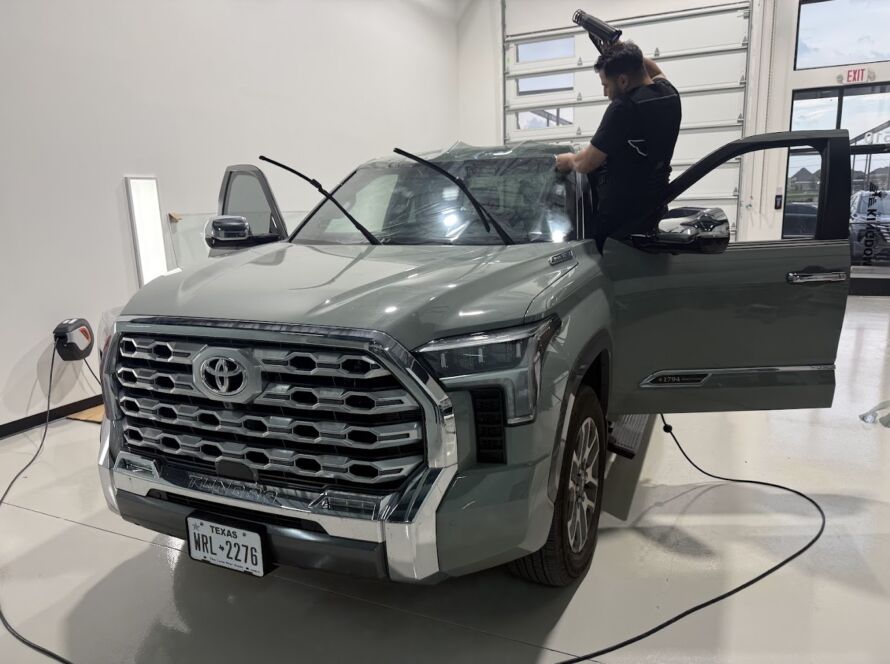
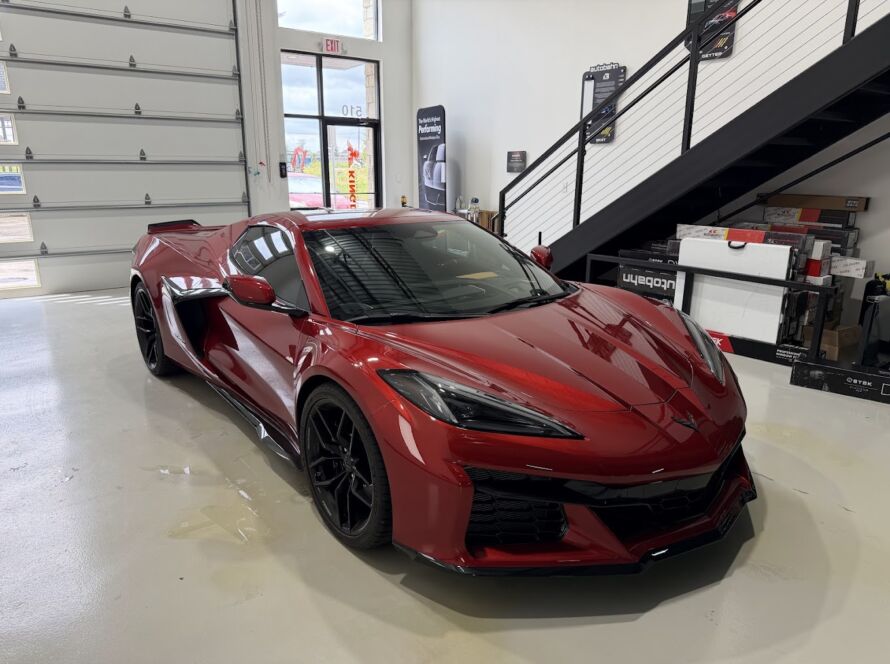
Short answer: Ceramic window tint is film made with non-metal ceramic particles that block heat from the sun without having to be dark and without interfering with phone or GPS signals. Every major brand makes one: 3M, LLumar, SunTek, Autobahn, Rayno, Huper Optik and more. By the makers’ own spec sheets, the top ceramic lines reject roughly 62% to 74% of the sun’s total heat at their darkest shade. At our Lewisville shop, ceramic tint for a full car costs $360 to $699.
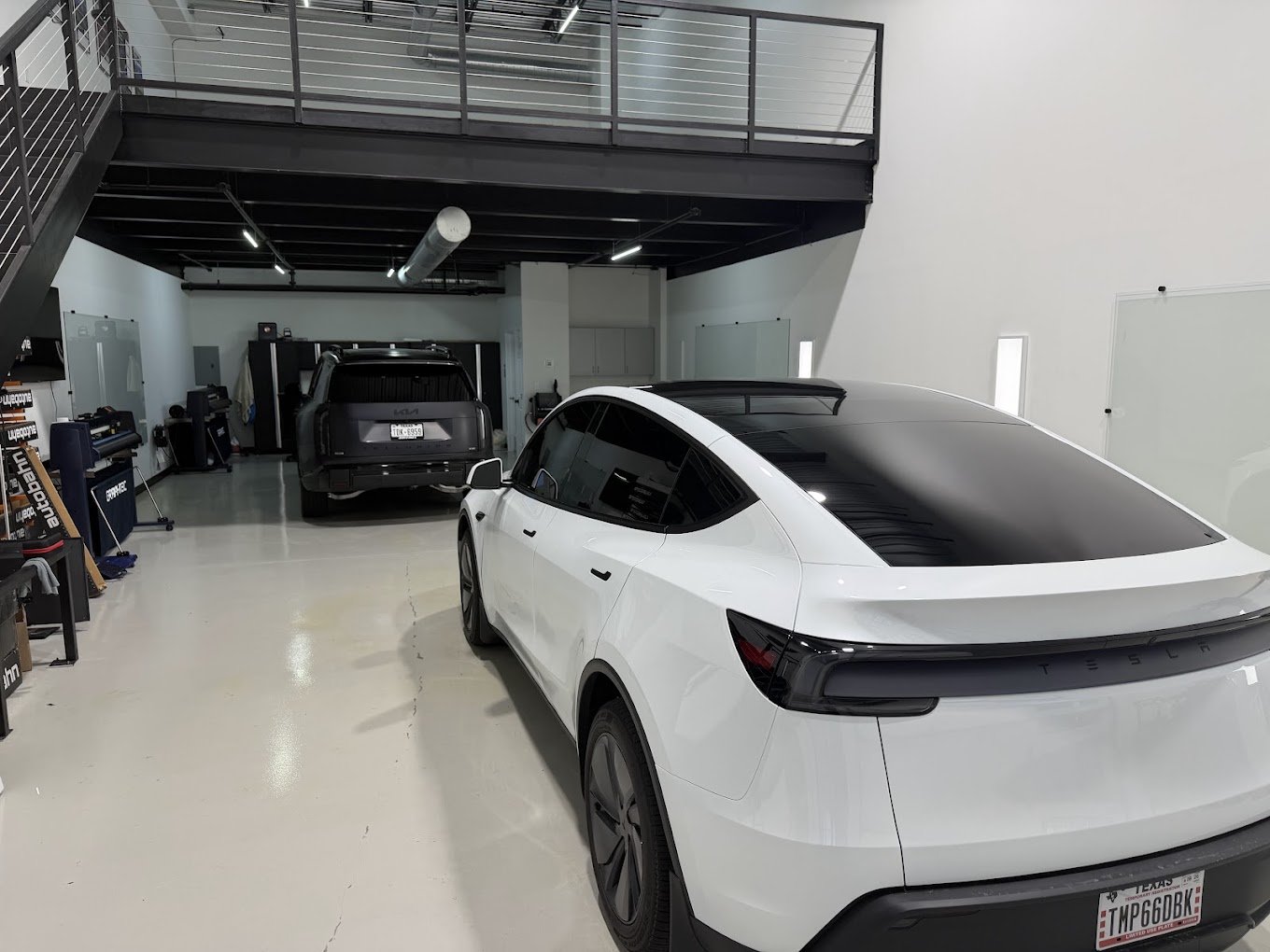
Every shop says “ceramic.” This page shows what that word means on a spec sheet: what ceramic film is, how to read the numbers, and how the ceramic lines from the big brands compare when you line up their published data. Then it covers the ceramic films we install and what they cost.
What Is Ceramic Window Tint?
Window film is a thin polyester sheet with an adhesive on one side. What makes it “ceramic” is what’s built into it: tiny ceramic particles that absorb and block infrared light, the part of sunlight you feel as heat. Older films did the job in other ways, and each had a catch:
| Film type | How it works | The catch |
| Dyed | Dye in the film absorbs light | Least heat rejection; the dye can fade, often to purple |
| Metalized | Metal particles reflect heat | Shiny look; can interfere with phone, GPS and radio signals |
| Carbon | Carbon particles absorb light | Better than dyed, but well below ceramic on heat |
| Ceramic | Non-metal ceramic particles block infrared | Costs more |
Two things follow from that. Ceramic film can reject a lot of heat in a light shade, which matters on front doors where Texas sets a limit. And because there’s no metal in it, it doesn’t block signals for phones, GPS, toll tags or the sensors behind the glass on newer cars.
Not every film sold as ceramic is built the same way. 3M calls its Ceramic IR “absorptive nano-ceramic,” Huper Optik uses titanium nitride, Rayno describes Phantom as a “carbon ceramic” hybrid, and 3M’s Crystalline isn’t ceramic at all: it’s a multilayer optical film with over 200 layers. What you can compare across all of them is the published performance.
How to Read a Ceramic Tint Spec Sheet
- VLT (visible light transmission): how much light gets through. A “5” shade lets in about 5%; a “70” lets in about 70%. This is the number Texas law uses.
- TSER (total solar energy rejected): the share of the sun’s total energy the film keeps out, including heat. This is the best single number for comparing heat. We explain it in what TSER really means.
- IR rejection: the number most ads lead with, and the easiest one to misread. See below.
- UV rejection: every ceramic line here is rated at 99% or more, so it won’t separate them.
Why the “95% IR” Number Can Mislead You
Brands don’t measure infrared the same way, and the band they measure changes the number a lot:
- 3M rates Ceramic IR at up to 95% IR rejection, measured from 900 to 1,000 nanometers on the film alone, without glass. On the same film, 3M’s full-band figure (IRER, 780 to 2,500 nm) is 67%.
- SunTek lists its Evolve film at 93% to 94% on one infrared measure (SIRR) and 64% to 65% on another (IRER). Same film, two numbers 30 points apart.
- Some brands publish an IR percentage without saying how it was measured at all.
So a 95% IR film and a 90% IR film from different brands may not differ at all in the car. Compare TSER first, at the shade you’ll actually put on the glass.
Ceramic Tint Brands Compared: The Published Numbers
Here is the best heat rejection each brand publishes for its top ceramic lines, at the darkest shade, with links to the maker’s own data:
| Brand and line | Darkest shade TSER | What the maker calls it |
| Autobahn i3+ | 74% | Top-tier ceramic |
| Autobahn Ceramic i3 | 71% | Top-tier ceramic |
| Huper Optik X3 Ceramics | 70% to 71% | Titanium nitride nano-ceramic |
| Rayno Phantom S9 | 70% | Carbon ceramic hybrid |
| 3M Ceramic IR | 66%* | Absorptive nano-ceramic |
| Madico WINCOS | 66% | Nano-ceramic |
| Johnson Supreme IR | 66% | Multi-layered nano-ceramic |
| SunTek Evolve | 65% | Ceramic nanoparticle |
| LLumar FormulaOne Stratos | 65% | Nano-ceramic |
| Autobahn Black Ceramic | 63% | Ceramic |
| SunTek CIR | 62% | Ceramic nanoparticle |
| LLumar IRX | 62% | Nano-ceramic |
| LLumar CTX | 58% | Ceramic |
*3M measures on 1/4-inch automotive green glass; on clear glass its darkest Ceramic IR is 63%. That’s the main caveat with this table: the makers don’t all test on the same glass (3M uses green automotive glass, SunTek and LLumar 6 mm clear glass, Huper Optik 3 mm clear glass, and Autobahn doesn’t say). Treat a gap of a few points as a tie. A gap of 10 points is real.
For comparison, the same sheets put non-ceramic films lower: Autobahn Black at up to 43%, SunTek’s Carbon at 46% and LLumar’s dyed ATC at 44%, all at the darkest shade.
At a Shade You Can Legally Run on the Front Doors
The darkest shade is what ads quote, but in Texas the front side windows have to let at least 25% of light through. So the more useful comparison is a shade around 30%, a typical legal choice for front doors:
| Film at about 30% | TSER |
| Autobahn i3+ 30 (measures 32%) | 64% |
| Autobahn Ceramic i3 33 | 62% |
| 3M Ceramic IR 30 | 60%* |
| Huper Optik Ceramics 30 | 60% |
| Rayno Phantom S9-30 | 59% |
| SunTek Evolve 30 | 58% |
| LLumar IRX 30 | 56% |
| SunTek CIR 30 | 55% |
| LLumar CTX 30 | 49% |
Light transmission is measured through the film and the glass together, and factory glass isn’t perfectly clear, so it’s worth leaving some margin above 25%. The full rules for every window are in our Texas tint law guide, and what each percentage looks like is in window tint percentages explained.
Who Makes Each Brand
- 3M is based in St. Paul, Minnesota. Its automotive lines include Ceramic IR and Crystalline.
- LLumar, SunTek and Huper Optik are all owned by Eastman Chemical Company. LLumar and SunTek are made by Eastman Performance Films in Virginia.
- Autobahn was founded in 2011 and lists its contact address in Houston, Texas.
- Rayno lists offices in Korea and California.
- Madico is based in the Tampa Bay area of Florida.
Brand-level differences, including each maker’s full range from entry film to top ceramic and how their warranties compare, are in our window tint brand comparison.
The Ceramic Films We Install, and What They Cost
Our price list is Autobahn and 3M. We’re certified by both, and every person on our team is certified. Three of the four films on our price list are ceramic, and we quote Autobahn’s top i3+ per vehicle:
| Film | Coupe | Sedan | Pickup | SUV | Darkest-shade TSER |
| Autobahn Ceramic | $360 | $449 | $499 | $499 | 63% |
| 3M Ceramic IR | $499 | $599 | $649 | $649 | 66%* |
| Autobahn Ceramic i3 | $549 | $649 | $649 | $699 | 71% |
| Autobahn i3+ | Quoted | Quoted | Quoted | Quoted | 74% |
Prices cover the side windows and back glass. A ceramic windshield is $250 to $350. The full list, including our non-ceramic Autobahn Black, is on our window tint prices page, and what a finished job adds up to is in how much it costs to tint car windows.
If you’re deciding between our two top films, read Autobahn i3 vs 3M Ceramic IR. If you’re deciding whether i3 is worth it over the first ceramic step, read is the Autobahn i3 upgrade worth it. Every Autobahn film, shade by shade, is in our Autobahn window tint review.
Where Ceramic Tint Makes the Most Difference
- Cars with glass roofs. Tesla glass already blocks UV, but not infrared, and a Model Y’s roof is a huge piece of glass. More in Tesla Model Y tint and the glass roof.
- The windshield. It’s the biggest piece of glass over the dash. Many drivers choose a light ceramic film there; read what Texas law says about windshield tint first.
- Long hours in the car. Commuters, families and work trucks. For trucks, see the best tint for trucks and SUVs.
- Texas summers in general. Book before the heat arrives; see getting tinted before the first 100-degree week.
Choosing among ceramic films? Our picks by situation are in the best ceramic window tint.
FAQ
What is ceramic window tint?
Window film made with non-metal ceramic particles that block infrared heat. It rejects more heat than dyed or carbon film at the same darkness and doesn’t interfere with electronic signals.
Which ceramic tint brand blocks the most heat?
On the makers’ published sheets, Autobahn i3+ lists the highest darkest-shade TSER we found at 74%, followed by Autobahn Ceramic i3 and Huper Optik X3 at 70% to 71% and Rayno Phantom S9 at 70%. The makers test on different glass, so small gaps aren’t meaningful.
Is 3M ceramic tint 95% IR rejection?
3M rates Ceramic IR at up to 95% IR rejection measured between 900 and 1,000 nanometers on the film alone. Its total solar energy rejection is up to 66% on automotive glass.
How much does ceramic tint cost?
At our Lewisville shop, $360 to $699 for the side windows and back glass, depending on the film and the car. A ceramic windshield is $250 to $350.
Does ceramic tint have to be dark to block heat?
No. That’s the main advantage of ceramic. Autobahn’s Ceramic i3 rejects 60% of total solar energy at its 40 shade, which is legal on Texas front doors.
Does ceramic tint interfere with phone or GPS signals?
No. Ceramic film has no metal in it. Metalized film is the type that can cause signal problems.
Who owns LLumar and SunTek?
Both are Eastman Chemical Company brands, made by Eastman Performance Films. Huper Optik is also an Eastman subsidiary.
Get Ceramic Tint in Lewisville
Tell us the car and we’ll help you pick the film. Get a quote with our online form or call (469) 234-5994. We’re at 2601 E State Hwy 121, Building 5, Suite 510, Lewisville, TX 75056.